The Hardest Problem in Blue Carbon Isn't Finance or Policy — It's Getting the Trees to Survive
News
 Willie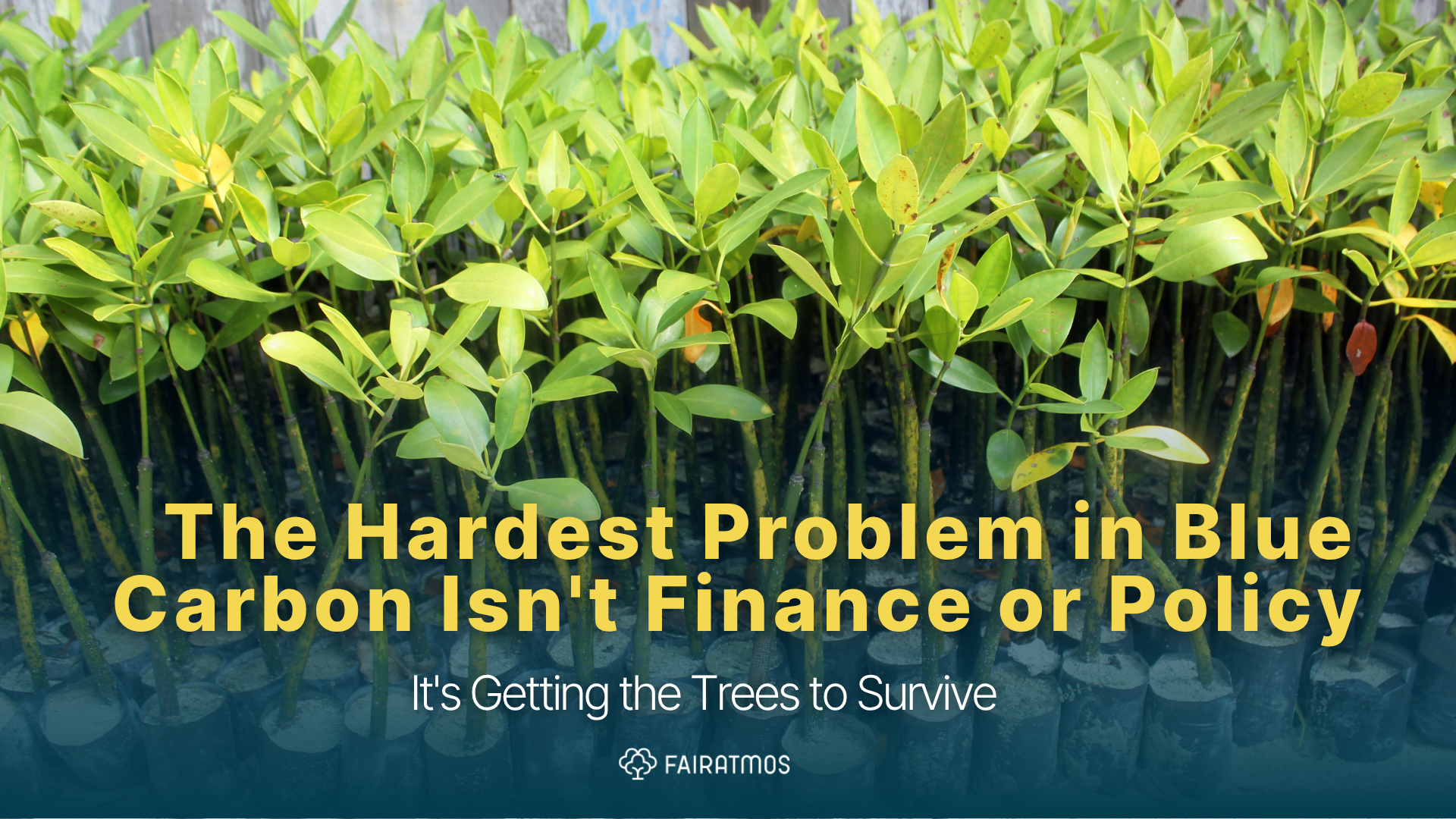
Jakarta, 25 May 2026
Everyone talks about planting mangroves.
Almost no one talks about what happens to them afterward.
Blue carbon is having a moment. Carbon credit demand is rising. Coastal restoration funding is accelerating. Governments across Southeast Asia are making mangrove commitments in their NDCs. The narrative is optimistic — and for good reason. Mangroves sequester carbon at three to five times the rate of tropical forests per hectare, store it in sediment for millennia, and anchor coastal ecosystems that millions of people depend on.
But the survivability problem is real, persistent, and systematically underreported.
Mangrove restoration projects across the region routinely plant hundreds of thousands of seedlings. A significant portion of them die — within months, sometimes weeks. Tidal dynamics. Wrong species in the wrong microhabitat. Nursery stock that wasn't hardened correctly before planting. Gaps in post-planting monitoring that miss early stress indicators until it's too late to intervene.
When seedlings die at scale, the carbon credit projections built on those planting numbers become unreliable. The additionality claims weaken. The verification bodies ask harder questions. And the communities who were supposed to benefit from a functioning coastal forest are left with rows of dead sticks in the mud.
This is the problem FairAtmos and YAKOPI are working to solve together.
TL;DR: Mangrove survivability is blue carbon's most underaddressed technical challenge. High planting numbers mean nothing if the seedlings don't survive. FairAtmos and YAKOPI — Yayasan Konservasi Pesisir Indonesia — have signed an MoU to develop joint research, smart nursery systems, and shared scientific knowledge to improve survivability rates across species. YAKOPI brings proven on-the-ground nursery capability, including a 90% survivability rate for Rhizophora species. FairAtmos contributes IoT infrastructure, MRV technology, and data analysis capacity. The goal: crack the survivability problem at species level, then build systems that can be replicated across project sites.
Why Is Mangrove Survivability Blue Carbon's Hardest Problem?
High survivability rates don't happen automatically — they are the product of deep site-specific knowledge, species-appropriate nursery practice, and continuous monitoring that most projects
don't have.
The gap between planting and surviving is where most blue carbon projects quietly underperform. A seedling that dies three months after planting was never a carbon credit — but it was counted as one in the project design. This creates a structural integrity problem: projects that report planting numbers without survivability data are building their carbon projections on assumptions rather than evidence.
The technical reasons behind low survivability are well understood in the restoration ecology literature, but rarely addressed systematically on the ground:
-
Species-habitat mismatch: Different mangrove species have specific requirements for tidal inundation frequency, salinity, sediment type, and light exposure. Planting Avicennia in a zone suited to Rhizophora — or vice versa — produces predictable failure.
-
Nursery stock quality: Seedlings raised in conditions that don't match their eventual planting environment experience transplant shock. Hardening protocols — gradually exposing nursery stock to site conditions before planting — are essential and often skipped.
-
Post-planting monitoring gaps: Early stress indicators in mangrove seedlings are visible before mortality, but only if someone is looking. Without systematic monitoring in the weeks following planting, problems compound before intervention is possible.
-
Knowledge asymmetry: The practitioners who understand these variables best — who have spent years watching what survives and what doesn't in specific coastal geographies — rarely have mechanisms to translate that knowledge into scalable, replicable systems.
YAKOPI is one of the few organizations in Indonesia that has systematically addressed these challenges — and achieved documented results.
What Has YAKOPI Already Proven?
YAKOPI — Yayasan Konservasi Pesisir Indonesia — is not a new entrant to mangrove restoration. They are one of Indonesia's most experienced blue carbon implementors, with deep on-the ground operational capability in coastal ecosystem management.
Their most significant documented achievement is achieving a 90% survivability rate for Rhizophora species within nursery operations, the dominant mangrove genus in many Indonesian coastal restoration sites. In an industry where survivability data is rarely published and often disappointing, this is not a minor improvement. It is a benchmark that most blue carbon projects in the region have not approached.
This result was not achieved by accident. It reflects years of nursery practice refinement — understanding the specific conditions under which Rhizophora propagules need to be raised, how long they need to mature before planting, what the optimal planting window looks like for different tidal regimes, and how to monitor early-stage establishment to catch problems before they become losses.
The gap that remains: this level of expertise currently applies to Rhizophora. For other mangrove species — Avicennia, Sonneratia, Bruguiera, Ceriops, and others that are critical for restoring the full ecological complexity of a coastal forest — the same depth of nursery knowledge and documented survivability data does not yet exist at this level.
That is precisely where the collaboration begins.
What Are FairAtmos and YAKOPI Building Together?
The MoU signed between FairAtmos (PT Udara Untuk Semua) and YAKOPI formalizes a research and development partnership with three interconnected workstreams.
1. Smart Nursery Development
The core collaboration: building a jointly designed nursery system that integrates YAKOPI's operational expertise with FairAtmos's IoT infrastructure and data capabilities.
A smart nursery is not simply a nursery with sensors. It is a system that continuously collects data on the conditions that determine seedling health — soil moisture, salinity, temperature, light exposure, tidal influence — and uses that data to inform nursery management decisions in real time. When combined with YAKOPI's practitioner knowledge about what healthy seedlings look like at each stage of development, this creates a feedback loop that can identify problems early, test interventions systematically, and build an evidence base that is transferable to other sites and species.
The immediate research focus: developing the nursery protocols for mangrove species beyond Rhizophora that currently lack the same depth of documented care standards. Avicennia marina, Sonneratia alba, Bruguiera gymnorrhiza — each has different salinity tolerances, different propagule characteristics, different optimal planting windows. Understanding these variables systematically, and building nursery environments that can reliably produce high-survivability stock for each, is the technical challenge the collaboration is designed to address.
2. Joint Academic Research and Knowledge Publication
The knowledge generated by the smart nursery will not stay internal. FairAtmos and YAKOPI have committed to developing joint academic publications — research frameworks, field data analysis, and peer-reviewed or practitioner-facing outputs — based on what the collaboration produces.
This is significant for two reasons. First, the mangrove restoration field in Southeast Asia is systematically underserved by published, site-specific survivability data. Most of what practitioners know lives in organizational memory, not in accessible literature. Publishing rigorous findings contributes directly to the ecosystem of knowledge that the whole sector depends on. Second, peer-reviewed publication is itself a form of verification — it subjects methodology and results to external scrutiny, which strengthens the credibility of the work and the organizations behind it.
3. Carbon Project Development Exploration
The longer-term arc of the collaboration is carbon project development, applying the joint nursery capability and research foundation to specific landscapes where high-integrity blue carbon projects could eventually be developed and verified.
This is explicitly framed as an exploration in the current MoU, the research and capability building comes first, and the carbon project pathway follows once the technical foundation is established. This sequencing is intentional. Blue carbon projects built on robust nursery practice and documented survivability data are fundamentally different from those built on planting targets alone. The former can defend their additionality claims, their permanence assumptions, and their co-benefit projections under verification scrutiny. The latter cannot.
Why Does This Collaboration Matter for the Blue Carbon Market?
The FairAtmos-YAKOPI partnership addresses a credibility problem that the blue carbon market has been slow to confront directly.
Carbon credits are supposed to represent real, measurable, permanent emissions reductions or removals. In blue carbon, that chain of accountability runs directly through survivability. A credit issued against a mangrove planting event that produces 40% long-term survival is not a high integrity credit — it is a projection built on optimistic assumptions about what was planted, not what survived.
The voluntary carbon market is moving toward higher scrutiny. Verra's updated methodologies, Gold Standard's co-benefit requirements, and the increasing due diligence standards of institutional buyers are all pushing in the same direction: show us the data, not the planting numbers.
Smart nursery systems that produce documented, species-specific survivability data and that can translate that knowledge into replicable protocols across project sites are exactly what the market needs to build the technical foundation for high-integrity blue carbon credits.
"The difference between a mangrove planting event and a verified carbon credit is survivability data. One tells you what went in the ground. The other tells you what is still growing — and why."
This is the problem FairAtmos and YAKOPI are building toward solving. Not just for their own projects, but for the methodological foundation of blue carbon as a credible asset class in Indonesia and across the region.
What This Means for FairAtmos's Project Development Capability
For FairAtmos, this collaboration is a direct investment in the technical depth that blue carbon project development requires.
Building AtmosCheck and AtmosDev on top of a foundation of real survivability knowledge — species-specific nursery protocols, IoT-monitored growth data, field-validated planting methodologies — produces something that generic feasibility tools cannot: project designs whose biological assumptions are grounded in documented evidence rather than regional averages.
The IoT and MRV infrastructure that FairAtmos brings to the smart nursery through AtmosWatch does more than collect data. It creates a continuous monitoring environment where the correlation between nursery conditions and field survivability can be tracked, tested, and refined over time. This is how institutional knowledge gets built — not through single project cycles, but through systematic data accumulation across species, sites, and seasons.
For YAKOPI, FairAtmos's technology layer transforms field expertise that currently lives in practitioner experience into structured, transferable, publishable knowledge. The 90% Rhizophora survivability rate they have achieved is remarkable. The smart nursery collaboration creates the mechanism to understand precisely why — and to apply that understanding to species where the same results have not yet been achieved.
Conclusion: Capability First, Credits Follow
Blue carbon's credibility problem is not a narrative problem or a marketing problem. It is a technical problem — and it requires technical solutions built by people who understand what actually happens in coastal restoration sites, not just what is supposed to happen.
FairAtmos and YAKOPI are approaching this correctly: capability first, carbon credits as the downstream outcome of genuine technical mastery. Joint research. Smart nursery systems. Published findings that the whole sector can use. Carbon project development built on a foundation of documented survivability data rather than optimistic projections.
The mangroves that survive are the ones that matter. And building the knowledge infrastructure to make that survivability reliable, species-specific, and scalable is the work that will determine whether blue carbon in Indonesia becomes a credible asset class — or another chapter in the story of environmental finance that over-promised and under-delivered.
FairAtmos (PT Udara Untuk Semua) and YAKOPI (Yayasan Konservasi Pesisir Indonesia) signed their MoU for joint research and smart nursery development on April 28, 2026, in Jakarta. The collaboration covers smart nursery development, joint academic publication, and exploration of blue carbon project development opportunities.
Tags: blue carbon Indonesia · mangrove survivability · smart nursery mangrove · FairAtmos YAKOPI · blue carbon research · mangrove restoration Indonesia · IoT mangrove monitoring · carbon credit integrity · coastal ecosystem restoration
For Buyers & Investors
Explore verified, high-impact projects like this through AtmosFund & invest in the future of sustainable landscapes.
Explore AtmosFundFor Landowners & Project Starters
Learn how your land could qualify for carbon project development through AtmosCheck.
Sign Up Now