Bridging the Conceptual Gap: Why Planting Patterns are the Foundation of Modern Agroforestry
News
Science
 Willie
In theory, land management sounds simple: to restore a forest, you plant trees. However, in practice, There is a significant gap between the conceptual goal of 'reforestation' and the precise ecological and economic modeling required to make agroforestry both sustainable and profitable.
The Problem: The High Cost of "Haphazard" Planting
The most common practice in restoration today is Haphazard Planting. This happens when species are scattered across a plot without a strategic architectural plan. While the intention is good, the results are often "painful" for project developers, asset owners or relevant stakeholders:
-
Stunted Growth & High Dieback: Miscalculated density creates two lethal extremes. Overcrowding leads to resource strangulation, where roots compete for nutrients and dominant canopies shade out smaller species. Planting too sparsely also destroys the essential forest microclimate; without shade, saplings—particularly sensitive crops like coffee or cacao—quickly die from sunscald and rapid soil dehydration.: Without a plan, trees are often placed too close together. They compete for limited root space and nutrients, or larger canopy trees shade out smaller species before they can even mature.
-
Biological Warfare: A common oversight in land management is the role of allelopathy, the 'chemical warfare' waged by certain species. When these plants are grouped together, they release bioactive compounds that actively suppress the development and productivity of their neighbors.
-
Logistical Failures: A plan that looks perfect "on paper" often fails on a 30-degree slope or irregular terrain. This leads to massive over or underestimation of seedling costs and labor requirements, draining project budgets.
The Solution: Understanding the Planting Pattern in Agroforestry
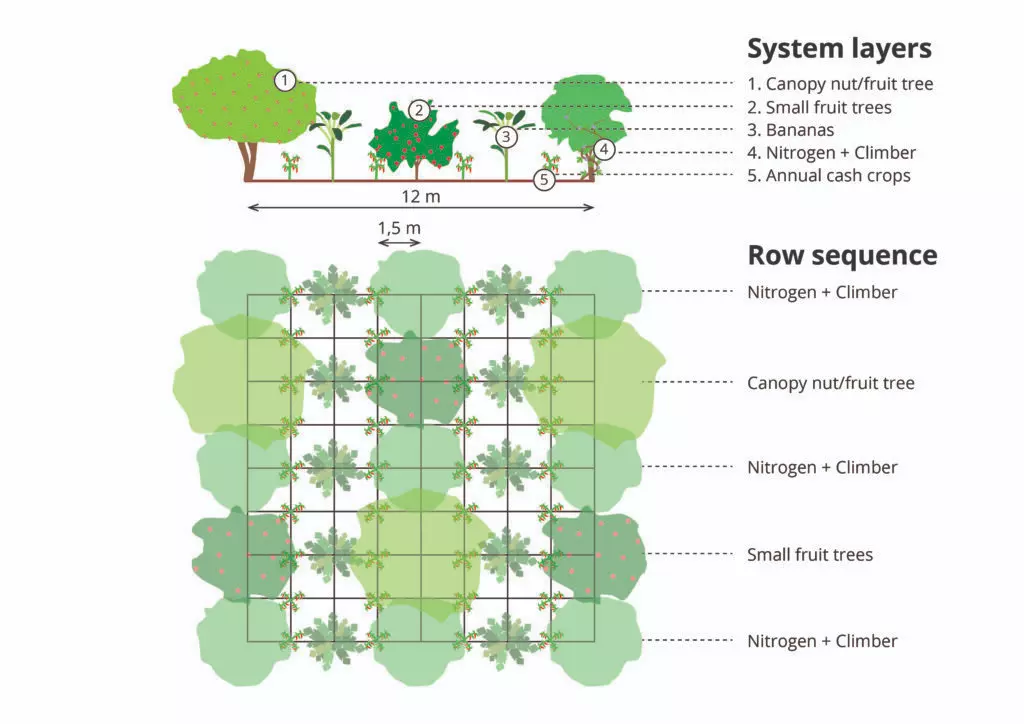
A Planting Pattern is a calculated system that combines agricultural species (short-term lifespan) with forestry species (long-term lifespan). It is the "bridge" that turns a chaotic plot of land into a structured, productive ecosystem.
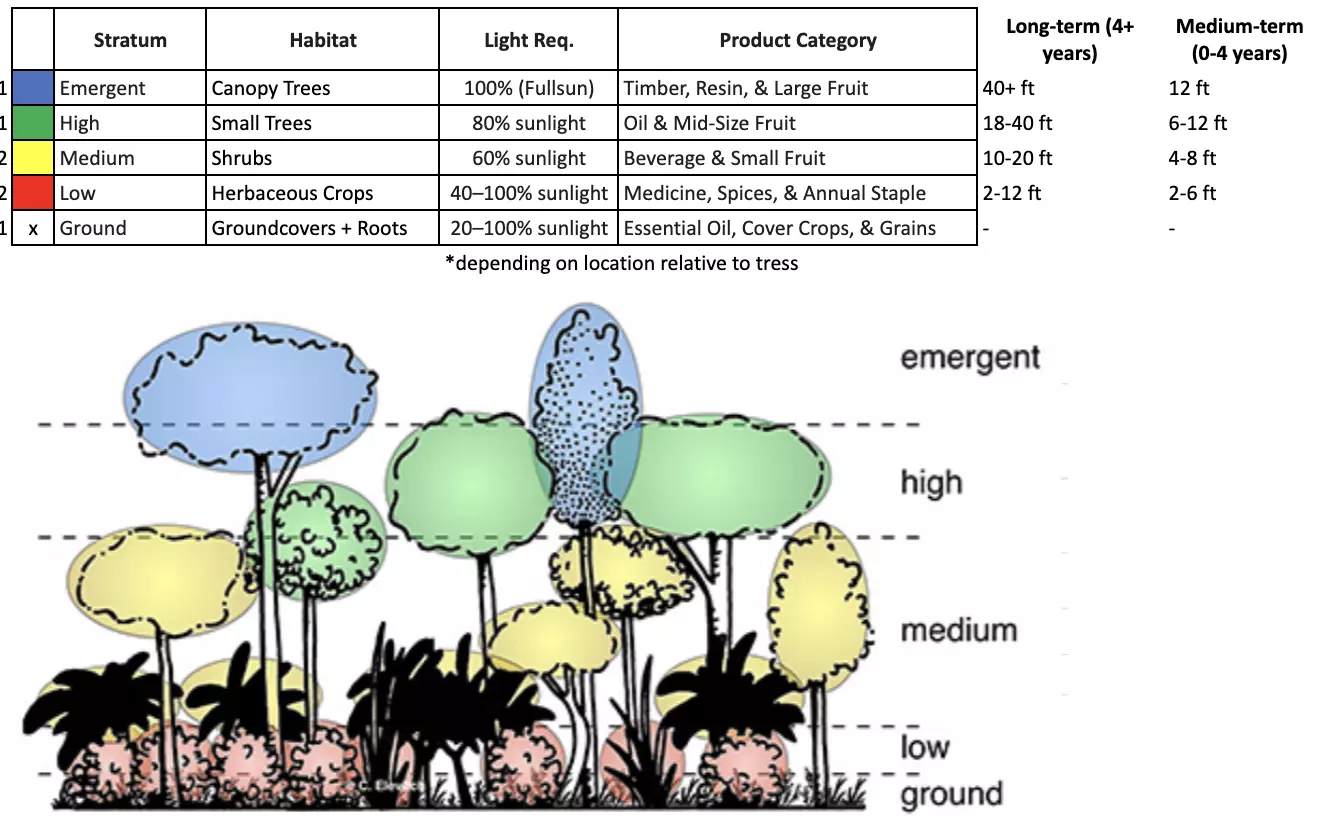
By using a 5-Strata Logic, we can design a forest that grows vertically, maximizing every inch of sunlight:
-
Emergent Layer (100% Light): Tall timber species like Teak or Albasia.
-
High Strata (~80% Light): Large fruit or oil trees like Avocado or Coconut.
-
Medium Strata (~60% Light): Beverage crops or small fruit like Coffee and Citrus.
-
Low Strata (40-100% Light): Understory crops like Bananas or Ginger.
-
Ground Layer (20-100% Light): Cover crops and essential oils like Citronella.
Why Planting Patterns Matter for Your Project
Implementing a scientific planting pattern provides two transformative benefits:
-
Socio-Economic Harmony: In Indonesia, "tenurial conflicts" are the biggest threat to forest permanence. Communities often ask, "What do we get from this project today?" By using a planting pattern that intersperses long-term timber with fast-yielding commodities (1-2 years), you provide immediate livelihoods for local farmers while the forest matures. It is a "subtle" restoration that protects the environment without displacing the people.
-
Precision for Carbon Finance: For any project seeking Carbon Credits (Verified Carbon Units - VCU), "guesses" are not allowed. A planting pattern provides the exact number of seedlings per hectare and the precise spacing required for rigorous carbon calculations.
Bringing it to Life: Planting Pattern in AtmosCheck
Doing the deep-dive research to find the "perfect combo" of species and spacing is incredibly difficult. That is why we have integrated this logic directly into AtmosCheck.
As part of the FairAtmos ecosystem, AtmosCheck now allows you to:
-
Evaluate Project Eligibility: Use our engine to see if your land and species selection meet the criteria for high-integrity restoration.
-
Automate Complex Logic: Instead of spending weeks on research, our tool automatically suggests optimal species combinations and patterns based on the successional strata logic.
-
Field-Ready Blueprints: Get a precise count of seedlings and a layout that accounts for actual field conditions, closing the "intellectual gap" once and for all.
The engine uses combinatorial logic to simulate planting variations, ensuring each patch achieves maximum planting density with balancing environmental requirements with precision of implementation data.
AtmosCheck isn't just a monitoring tool; it is a design engine. By utilizing our new Planting Pattern feature, you ensure that your project is not just a collection of trees, but a scientifically optimized ecosystem ready for the global carbon market.
For Buyers & Investors
Explore verified, high-impact projects like this through AtmosFund & invest in the future of sustainable landscapes.
Explore AtmosFundFor Landowners & Project Starters
Learn how your land could qualify for carbon project development through AtmosCheck.
Sign Up Now