Beyond the Canopy: Indonesia’s Mangroves as a Biological Smart City
Science
 Willie
For decades, we have viewed mangroves through a singular lens: they are carbon sinks. While it is true that Indonesia’s mangroves are up to four times more effective at sequestering carbon than terrestrial forests, focusing only on carbon is like looking at a supercomputer and only commenting on how much electricity it uses.
New research from the National Research and Innovation Agency (BRIN) and the Indonesia Biodiversity Strategy and Action Plan (IBSAP 2025–2045) is revealing a much more complex story. Our archipelago isn't just a collection of trees; it is a Biological Smart City, a high-functioning, interconnected machine that engineers land, cleans water, and communicates through sound.
1. The Blueprint: A Masterclass in Diversity
The foundation of any great city is its diversity. Most global mangrove forests are "monospecific," consisting of only one or two dominant species. Indonesia, however, is the world’s botanical vault.
As of the latest 2025 National Mangrove Map, Indonesia hosts 48 "true" mangrove species, roughly 80% of the world's total diversity. This isn't just a biological trivia point; it is a survival strategy. Each species, from the towering Rhizophora to the salt-secreting Avicennia, plays a specific role. This diversity ensures that if one species is threatened by a specific pest or temperature shift, the "city" doesn't collapse. The ecosystem remains resilient, a quality that 2026 climate models suggest is our most valuable defense.
2. The Civil Engineers: Fluid Dynamics and Land Reclamation
While humans use concrete and steel to protect coastlines, Indonesian mangroves use Fluid Dynamics.
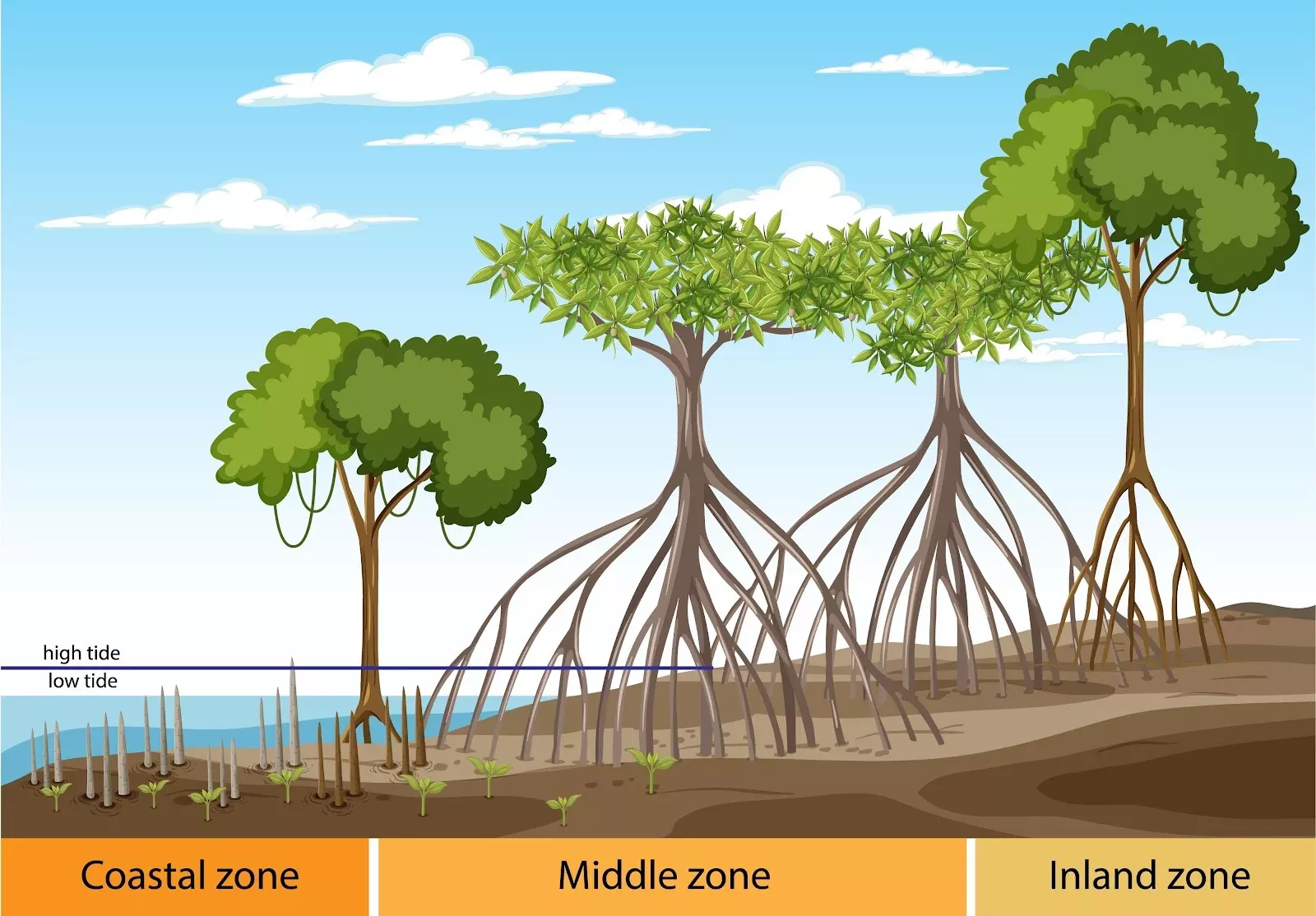
Recent 2025 studies from Universitas Gadjah Mada (UGM) have analyzed the "Energy Stock" of these forests. The complex, intertwining root systems of a multi-species forest create a "hydraulic brake." When tidal currents or storm surges hit the coast, these roots dissipate the energy, forcing suspended sediments to drop to the forest floor.
Essentially, our mangroves are land-builders. In an era of rising sea levels, these forests are vertically "raising" the coastline by trapping silt, creating a natural buffer that keeps the Indonesian archipelago above water.
3. The Maintenance Crew: Microbial Bioremediation
Every smart city needs a waste management system. In the mangrove forest this work happens at a microscopic level.
Research published by BRIN in late 2025 identified specific endophytic microbes, bacteria and fungi living within the mangrove roots that act as a natural filtration system. In industrial coastal zones, these microbes have the unique ability to break down heavy metals and hydrocarbons (oil spills) that get trapped in the anaerobic mud. They don't just store pollutants; they neutralize them, ensuring the water that flows back into the ocean is cleaner than when it entered.
4. The Communication Network: Listening to the Ecosystem
Perhaps the most "futuristic" development in 2026 is the use of Bioacoustics to monitor forest health.
Healthy mangroves are loud. By using specialized microphones, scientists can now identify the "acoustic signature" of a functioning ecosystem. A study from January 2026 notes that the frequency of snapping shrimp (Alpheus) and the dawn chorus of mangrove-dependent birds like the Mangrove Pitta are more accurate indicators of health than satellite imagery.
If a forest is silent, the "Smart City" is in trouble. This allows conservationists to move from "reactionary" protection to "real-time" intervention, ensuring the ecosystem's communication lines stay open.
The 2026 Reality: From Planting to Protection
Despite our scientific advancements, the situation remains delicate. While Indonesia has made significant strides, including the endorsement of the Global Mangrove Breakthrough, we are at a tipping point.
The old way of conservation was "planting a tree." The 2026 way is "Landscape Management." This involves:
-
Protecting Old-Growth DNA: Scientific data suggests that the genetic blueprint of ancient forests is more resilient than nursery-grown saplings.
-
Community-Led KLMs: The establishment of Mangrove Landscape Units (KLMs) ensures that local "Masyarakat Adat" are the primary guardians, using traditional wisdom alongside modern sensors.
-
Integrating Bio-solutions: Using natural biostimulants to help mangroves recover in polluted areas.
Final Thoughts
Indonesia is no longer just a participant in the global climate conversation; we are the laboratory for the world’s most advanced nature-based solutions. Our mangroves are a testament to what happens when evolution is given the space to engineer perfection.
To protect them is to protect the very machinery that keeps our coastlines stable, our water clean, and our biodiversity thriving.
Join the Movement
For Investors & Buyers: Are you ready to move beyond traditional offsets and toward high-impact, transparent environmental assets? Align your portfolio with projects that prioritize community resilience and biodiversity at their core. [Explore Impactful Opportunities at Atmosfund]
Sources & Further Reading (2023-2026):
-
BRIN (2025): Microbial Bioremediation in Tropical Mangrove Sediments.
-
UGM (2025): Energy Flux and Sedimentation Rates in Indonesian Coastal Forests.
-
Journal of Marine Science (Jan 2026): Bioacoustic Monitoring of the Indo-Pacific Blue Carbon Continuum.
-
Ministry of Environment (Dec 2025): The 2025 National Mangrove Map & IBSAP 2025-2045 Roadmap.
For Buyers & Investors
Explore verified, high-impact projects like this through AtmosFund & invest in the future of sustainable landscapes.
Explore AtmosFundFor Landowners & Project Starters
Learn how your land could qualify for carbon project development through AtmosCheck.
Sign Up Now